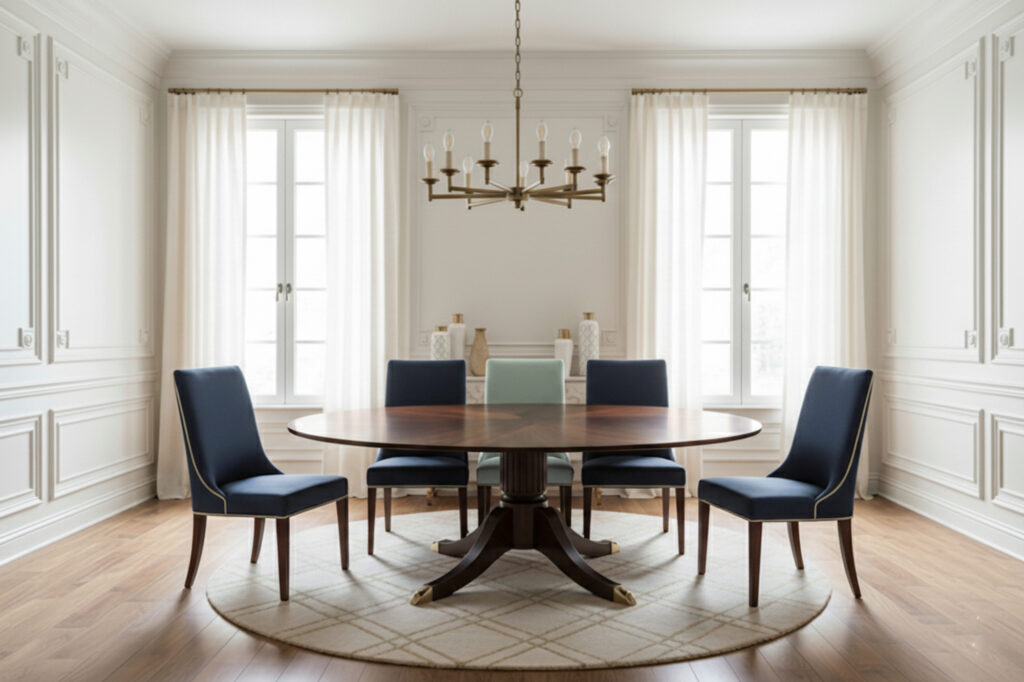
In the world of luxury furniture, few pieces evoke as much admiration as the Jupe table. Originally patented by Robert Jupe in 1835, this unique design has become the gold standard for homeowners who need versatility without sacrificing elegance. Whether you are hosting a cozy family breakfast or a grand dinner party, the Jupe table offers a seamless transition that traditional rectangular tables simply cannot match.
Alt-text: A high-end mahogany Jupe table expanded to its full diameter in a luxury dining room.
The Ingenuity of the Table Design
Traditional dining tables often expand by adding leaves to the center, which turns a circle into an oval. However, a Jupe tables expand radially. As the tabletop is rotated, the surface “blooms,” allowing for the insertion of perimeter leaves that maintain the table’s perfect circular shape. This mechanical wonder ensures that your expanding round dining table remains a symmetrical focal point in your room.
Why Choose a Jupe Style Table for Your Home?
Interior designers frequently recommend the Jupe table for circular or square dining rooms. Because the table grows in diameter rather than length, it preserves the “flow” of the room.
- Conversation Friendly: Unlike long banquet tables, the circular shape of a Jupe table ensures every guest can see and speak to one another easily.
- Space Efficiency: It maintains a small footprint for daily use but can expand to seat up to 12 people.
- Mechanical Beauty: The internal gearing of a high-quality mahogany Jupe table is a testament to 19th-century engineering.
Alt-text: Detail shot of the internal mechanical expansion gears of a mahogany Jupe table.
Craftsmanship and Quality in Every Jupe Table
Because these tables involve complex moving parts, the quality of construction is paramount. At Antique Purveyor, our table collection is built using solid mahogany and robust internal mechanisms. According to furniture history at the Victoria and Albert Museum, the original 19th-century designs were prized for their “extraordinary ingenuity,” a standard we strive to maintain in our modern reproductions.
We avoid the common issues found in cheaper versions, such as “binding” gears or uneven leaf alignment. A well-made Jupe table should operate smoothly with a simple push, revealing the beautiful “flame” mahogany grain that characterizes our finest pieces.
Pairing Your Table with the Right Seating
When styling your Jupe style table, consider the chair count in both its retracted and expanded states. Since the table expands outward, you will need a set of high-end dining chairs that are slim enough to fit comfortably around the perimeter. For more advice on choosing seating, the Architectural Digest guide to dining rooms offers excellent tips on scale and proportion.
Conclusion The Jupe table is more than just a piece of furniture; it is a mechanical masterpiece. By combining the social benefits of a round table with the capacity of a banquet table, it serves as the perfect solution for the modern host.